Why AI Gets Simple Things Wrong
-
Grant Elliott

- Jan 26
- 3 min read
And why it’s not ignoring you on purpose
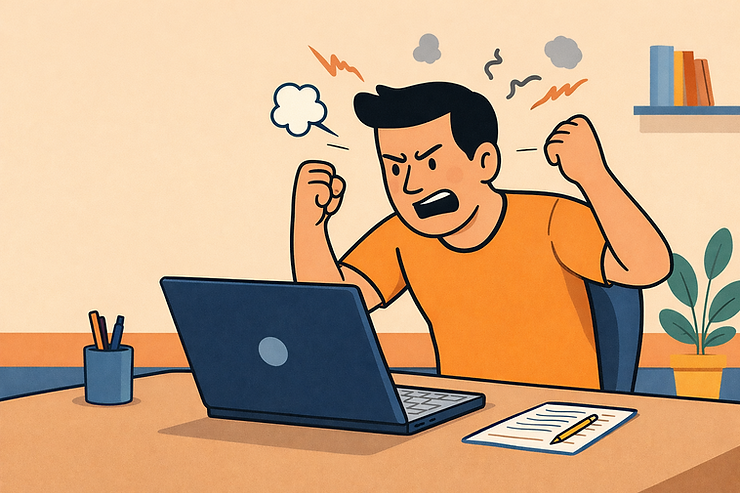
I will admit it. I have sworn at my AI.
Usually it happens when I ask for something simple. Reformat this text. Do not change the wording. Keep the structure exactly the same. And then it does the one thing I explicitly told it not to do. It rewrites sections. It changes formatting. It adds words. It summarizes. Sometimes it apologizes. Sometimes it confidently gives me the wrong thing again.
At that point it feels personal, even though I know it is not.
What makes it more frustrating is that in most other software, this would never happen. If I create a rule in Excel to filter a list, Excel does exactly what I told it to do. If there is a conflict, it throws an error. If the rule is invalid, it warns me.
AI does not work that way.
Prompts are not rules
When you write a prompt in ChatGPT, Gemini, or similar tools, you are not creating a rule. You are making a request.
That request is processed through a set of layers you never see. When there is a conflict between your instruction and something higher priority, the system resolves it quietly and gives you an answer anyway.
No warning. No error. Just output.
That is why AI can feel unpredictable. It is not ignoring you. It is negotiating.
The hidden hierarchy behind every response
The graphic below shows what is actually happening.
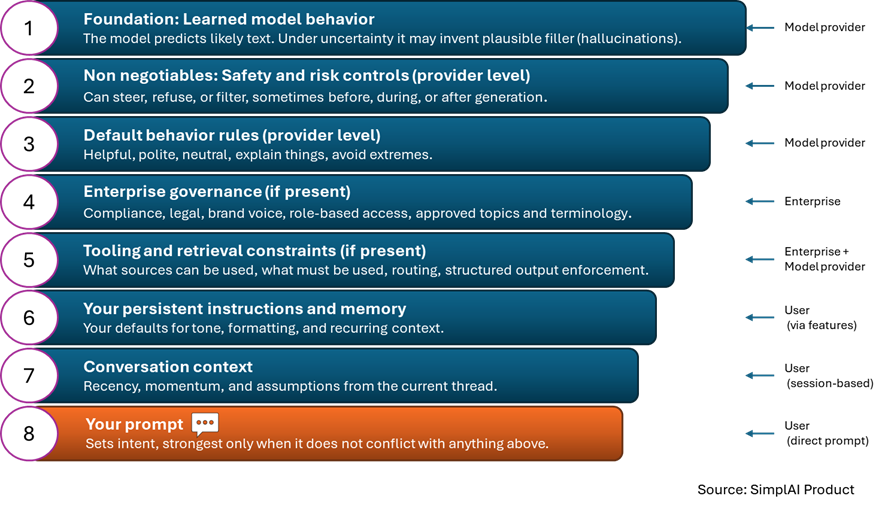
Your prompt sits at the very bottom of a logical stack. Every layer above it has more authority than the one below. When those layers disagree, the AI does not stop to ask which one you meant. It makes a judgment call.
At the foundation is the model itself. It predicts what text is most likely to come next. When information is missing or ambiguous, it fills the gap with something that sounds right. That is where hallucinations come from.
Above that are non negotiable safety and risk controls. These can block, filter, or reshape what the AI produces, sometimes before it even starts writing.
Next are default behavior rules. These push the AI to be polite, helpful, neutral, and explanatory, even when that is not what you asked for.
If you are using AI at work, there may also be enterprise rules in play. Legal constraints, compliance requirements, brand language, or approved terminology can all override your instructions.
Then there are tooling and retrieval constraints. These decide what sources can be used, what must be used, or whether the request is routed through a tool instead of answered freely.
Only after all of that do your own preferences come into play. Things like tone, formatting defaults, and prior instructions you have given the system. Then the current conversation context. And finally, at the bottom, your prompt.
This is why the graphic matters. Your prompt is not being followed or ignored in isolation. It is being filtered through everything above it.
Why simple tasks fail more often than complex ones
This sounds counterintuitive, but AI often struggles more with simple, precise tasks than with complex ones.
When you say “do not change anything” and also ask it to “clean this up,” you have already created a conflict. The AI will resolve that conflict without telling you how. If a detail is unclear, it will guess rather than stop.
That guessing is not stubbornness. It is how the system is designed to work.
How to reduce frustration
You do not need to become a prompt expert. A few small changes help.
1. Be clear about what must not change.
2. Avoid mixing goals in the same prompt.
3. Tell the AI what to do if it is unsure, for example to stop and ask a question instead of guessing.
Most importantly, remember this.
It is ok to get frustrated
AI feels human because it talks like a human. That makes it easy to treat it like one. But underneath, it is a system balancing competing instructions and trying to produce something useful without breaking higher priority rules.
Once you understand that your prompt is the last input in a much bigger hierarchy, the behavior starts to make sense. And writing better prompts stops feeling like arguing with a machine and starts feeling like guiding one.