Connect ideas to strategy, users, decisions, and validation in one traceable flow. Build the right product, at the right time, for the right reasons.
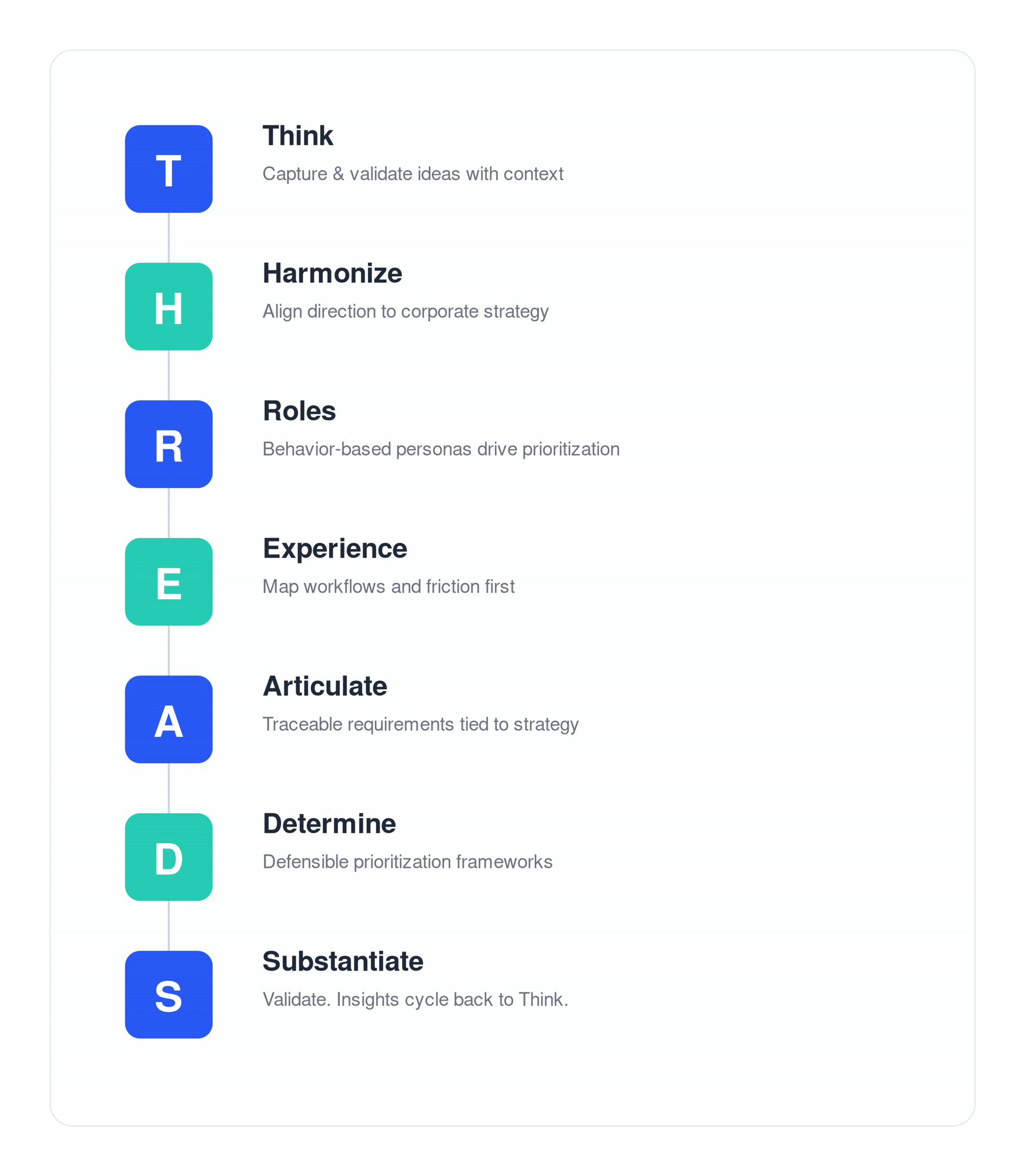
THREADS gives product leaders a connected, disciplined path from idea to validation.
Surface the true problem before jumping to solutions. Connect business goals to user reality.
Pressure-test thinking before it consumes resources. Reduce rework and late-stage surprises.
Defensible, traceable decisions. Clarify ownership and accountability across teams.
THREADS is not strictly linear. You can move forward, backward, and sideways. Every decision is interconnected.
Capture and validate ideas with context before they consume resources.
Align product direction to corporate strategy, metrics, and competitive priorities.
Define nuanced, behavior-based personas that drive real prioritization decisions.
Map workflows and friction before writing requirements.
Create structured, traceable requirements tied to personas and strategy.
Apply defensible frameworks aligned to agreed-upon strategic goals.
Measure outcomes, validate assumptions, and feed insights back into the system.
The THREADS framework ensures that your product strategy stays connected to user needs and business goals.
A clearer understanding of the problem space and a stronger foundation for the work ahead.
Think is the foundation of the framework. Before teams rush into roadmaps, features, or execution, they need to step back and think clearly about the opportunity in front of them.
This step focuses on defining the core problem, understanding what is driving the opportunity, and asking whether the initiative deserves attention in the first place.
AT THIS STAGE, ASK:
What problem are we actually trying to solve?
Why does this matter now?
What signal(s) suggest this is worth pursuing?
What assumptions are shaping our thinking?
A stronger connection between product thinking and business alignment, with fewer surprises later.
A promising idea is not enough. It also has to fit the broader business context.
Harmonize is about aligning the opportunity with company goals, market priorities, stakeholder expectations, and the practical realities of the organization. This is where teams pressure-test whether the initiative belongs in the bigger picture.
AT THIS STAGE, ASK:
Does this align with our strategy?
How does this fit with other priorities already in motion?
Are stakeholders aligned on the direction and value?
What tensions or tradeoffs need to be surfaced now?
Better accountability, smoother collaboration, and faster progress with less friction.
Strong product work breaks down when ownership is unclear. Teams lose time when responsibilities overlap, decisions stall, or accountability is distributed too loosely.
Roles brings clarity to who is involved, what each person or function is responsible for, and how collaboration should work across the initiative.
AT THIS STAGE, ASK:
Who owns the product decision?
Who contributes expertise, input, or approval?
Where do handoffs or dependencies create risk?
What needs to be clear now to avoid confusion later?
A grounded understanding of user reality, so product decisions reflect real needs.
Products succeed when they solve meaningful problems in ways that actually work for the people using them.
Experience centers on the customer, user, or buyer perspective, and helps teams understand behaviors, pain points, expectations, and context before they overinvest in a solution.
AT THIS STAGE, ASK:
Who is the user, buyer, or stakeholder experiencing the problem?
What is their current journey like?
Where is the friction, confusion, or unmet need?
What would meaningfully improve the experience?
A clearer, sharper product narrative that aligns teams and strengthens decision quality.
Articulate is where teams sharpen the market opportunity and define it so others can understand, evaluate, and support.
This stage clearly frames the problem, the value, the intended outcome, and the logic behind the direction. A team that cannot articulate the opportunity clearly is usually not ready to build.
AT THIS STAGE, ASK:
What are we proposing, and for whom?
Why will this matter to our audience?
What change or outcome are we trying to create?
How do we explain this in a way constituents can appreciate?
A more confident, deliberate path forward based on evidence, alignment, and structured judgment.
Determine is where teams assess options, make tradeoffs, and decide what should happen next.
By this point, the team has stronger context, clearer alignment, and better articulation. The next step is to determine whether to proceed, how to proceed, and what level of investment makes sense.
AT THIS STAGE, ASK:
Which option is strongest?
What are the biggest risks or unknowns?
What should be prioritized now versus later?
Is the team ready to move forward, or is more work needed?
A more defensible product decision — and greater confidence before major investment begins.
Substantiate ensures the decision holds up. Teams use evidence to confirm whether the proposed direction is credible and worth backing.
Validation can take many forms: research, interviews, prototypes, experiments, internal review, pilot testing, or other proof points that reduce uncertainty.
AT THIS STAGE, ASK:
What evidence supports this decision?
What still needs to be tested or validated?
Which assumptions remain risky?
What is the true level of confidence?
Don't leave product decisions to instinct or fragmented thinking. Get the framework risk-free.